
The Life of Artificial Intelligence: From Science Fiction to Everyday Life
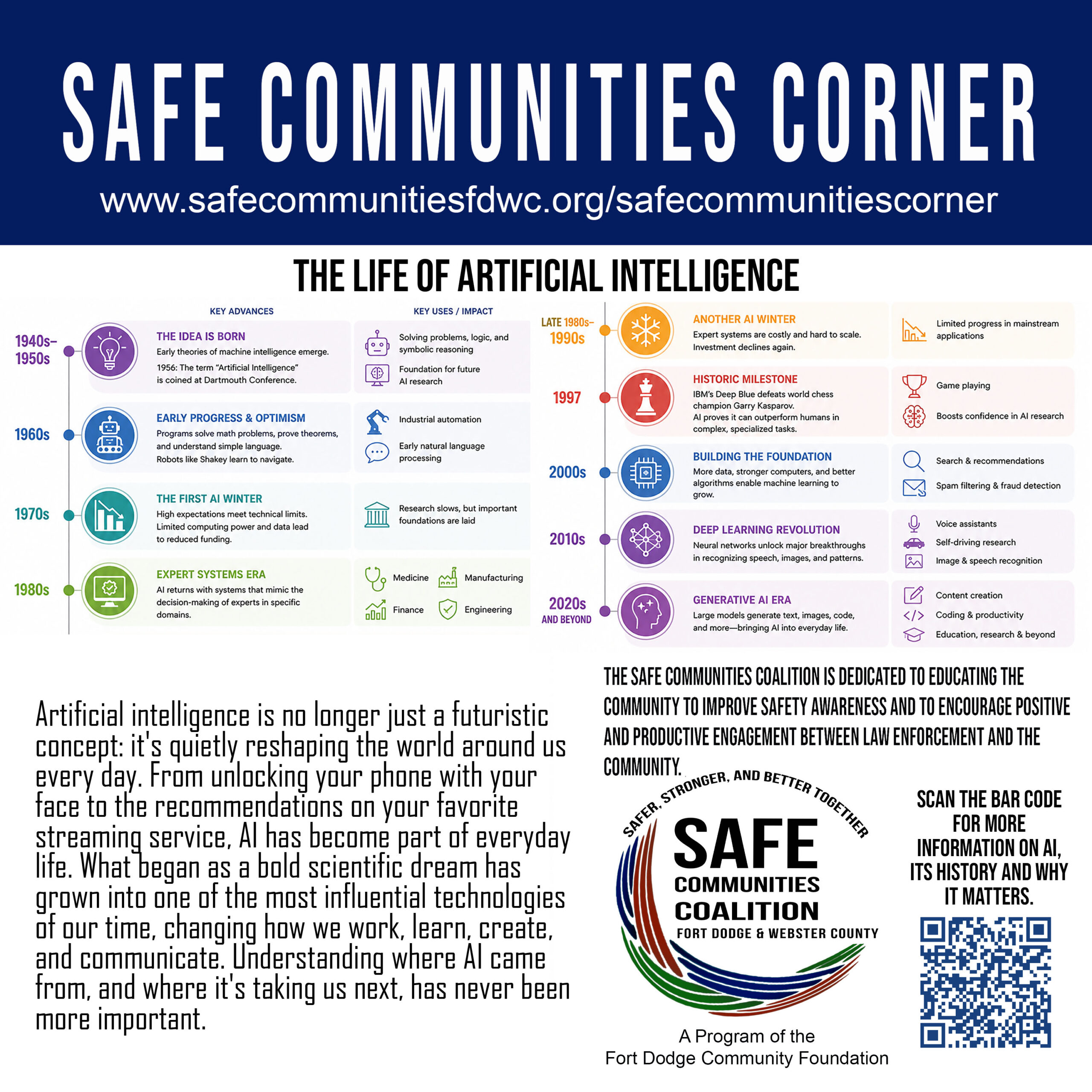
Artificial intelligence is no longer just a futuristic concept, it’s quietly reshaping the world around us every day. From unlocking your phone with your face to the recommendations on your favorite streaming service, AI has become part of everyday life. What began as a bold scientific dream has grown into one of the most influential technologies of our time, changing how we work, learn, create, and communicate. Understanding where AI came from, and where it’s taking us next, has never been more important.
The Birth of an Idea
The idea of creating machines that could “think” has fascinated scientists for generations. While the concept dates back centuries in literature and philosophy, the modern field of artificial intelligence officially began in 1956 when computer scientist John McCarthy coined the term Artificial Intelligence at the Dartmouth Conference.
Researchers believed that computers could eventually perform tasks requiring human intelligence, such as reasoning, problem-solving, and learning. Although early computers had limited processing power, the vision for AI had been established.
Early Successes and Early Setbacks
The 1960s brought optimism. Computers learned to solve mathematical problems, understand simple language, and even navigate basic environments. Researchers predicted that human-level AI might only be a few decades away.
Reality, however, proved much more difficult.
By the 1970s, limited computing power, scarce data, and unrealistic expectations caused funding to dry up in what became known as the first AI winter. Many believed artificial intelligence had been overhyped.
The Rise of Expert Systems
AI returned in the 1980s through expert systems: programs designed to mimic the decision-making abilities of specialists in fields such as medicine, finance, manufacturing, and engineering.
These systems couldn’t truly “think,” but they demonstrated that computers could assist professionals by making recommendations based on large sets of rules and data.
Unfortunately, these systems were expensive to build and difficult to maintain. By the late 1980s and early 1990s, investment slowed once again, leading to a second AI winter.
The Turning Point
Everything changed in 1997 when IBM’s Deep Blue defeated world chess champion Garry Kasparov.
Although Deep Blue wasn’t the kind of AI we use today, the victory proved that computers could outperform even the best humans in certain highly specialized tasks. It renewed confidence in AI research and inspired a new generation of scientists and engineers.
The Foundation for Modern AI
During the 2000s, several breakthroughs happened at once:
- Computers became dramatically more powerful.
- The internet created enormous amounts of digital data.
- Better algorithms allowed machines to learn from experience instead of simply following programmed rules.
These developments laid the groundwork for modern machine learning.
The Deep Learning Revolution
The 2010s transformed artificial intelligence from an academic field into something millions of people used every day.
Deep learning allowed computers to recognize faces, understand speech, translate languages, recommend movies, filter spam, detect fraud, and even assist doctors in identifying diseases.
Voice assistants like Siri, Alexa, and Google Assistant became household tools, while AI quietly improved everything from online shopping to navigation apps.
The Generative AI Era
Today’s AI represents another major leap forward.
Modern generative AI can create written content, realistic images, music, videos, computer code, and even scientific discoveries in seconds. Instead of simply recognizing information, AI can now generate entirely new content based on what it has learned.
Businesses use AI to improve productivity. Students use it as a learning tool. Artists use it to explore new creative possibilities. Scientists use it to accelerate research. Even small organizations can now access capabilities that were once available only to major corporations.
AI has become part of everyday life—and we’re only beginning to understand its potential.
Where Is AI Going Next?
While no one can predict the future with certainty, several trends are already beginning to emerge.
More Personal AI
Future AI systems will become increasingly personalized, learning individual preferences, schedules, and goals to serve as digital assistants that help organize daily life, education, healthcare, and finances.
Healthcare Breakthroughs
Artificial intelligence is expected to continue improving disease detection, personalized medicine, drug discovery, and patient monitoring. Rather than replacing physicians, AI will likely become a powerful tool that helps medical professionals make faster and more informed decisions.
Scientific Discovery
Researchers are already using AI to model climate systems, discover new materials, study distant galaxies, and accelerate breakthroughs that might otherwise take years or decades.
Smarter Transportation
Self-driving technology continues to improve, and AI is making transportation safer through collision avoidance systems, traffic optimization, predictive maintenance, and more efficient logistics.
Education for Everyone
AI tutors may soon provide individualized instruction for every student, adapting lessons to each person’s learning style and pace. This could make quality education more accessible across the world.
Creative Collaboration
Rather than replacing creativity, AI is becoming a creative partner. Writers, photographers, musicians, designers, filmmakers, and programmers are increasingly using AI to brainstorm ideas, automate repetitive tasks, and bring ambitious projects to life more quickly.
The Challenges We Must Address
Every technological revolution brings important questions.
Artificial intelligence raises concerns about privacy, misinformation, cybersecurity, employment, bias, and ethical decision-making. As AI becomes more powerful, society must ensure that it is developed responsibly and used in ways that benefit people rather than harm them.
Understanding AI isn’t just about learning how the technology works, it’s about learning how to use it wisely.
AI Is a Tool, How We Use It Matters
Artificial intelligence has traveled an incredible journey from a bold idea discussed in a university classroom in 1956 to a technology that influences nearly every aspect of modern life.
Like electricity, the internet, or the smartphone before it, AI is becoming part of the foundation of everyday society. It offers tremendous opportunities to improve healthcare, education, science, safety, and productivity. At the same time, it challenges us to think carefully about ethics, privacy, and human responsibility.
The future of AI isn’t something that will simply happen to us; it is something we will shape together. By understanding its history, recognizing its capabilities, and approaching it thoughtfully, we can help ensure that artificial intelligence remains a tool that enhances human potential rather than replaces it.
As AI continues to evolve, one thing is certain: its story is only just beginning. We’ll talk more next time about the importance of how we use AI.