

AI: A Deeper Dive Into the Consequences
What Parents Need to Know About How AI Can Affect the Way Children See, Think, and Understand the World
Artificial intelligence is changing the world around us. It can help us learn, create, solve problems, and connect—but it also creates new challenges, especially for children who are still developing the skills needed to evaluate information and understand what they see online.
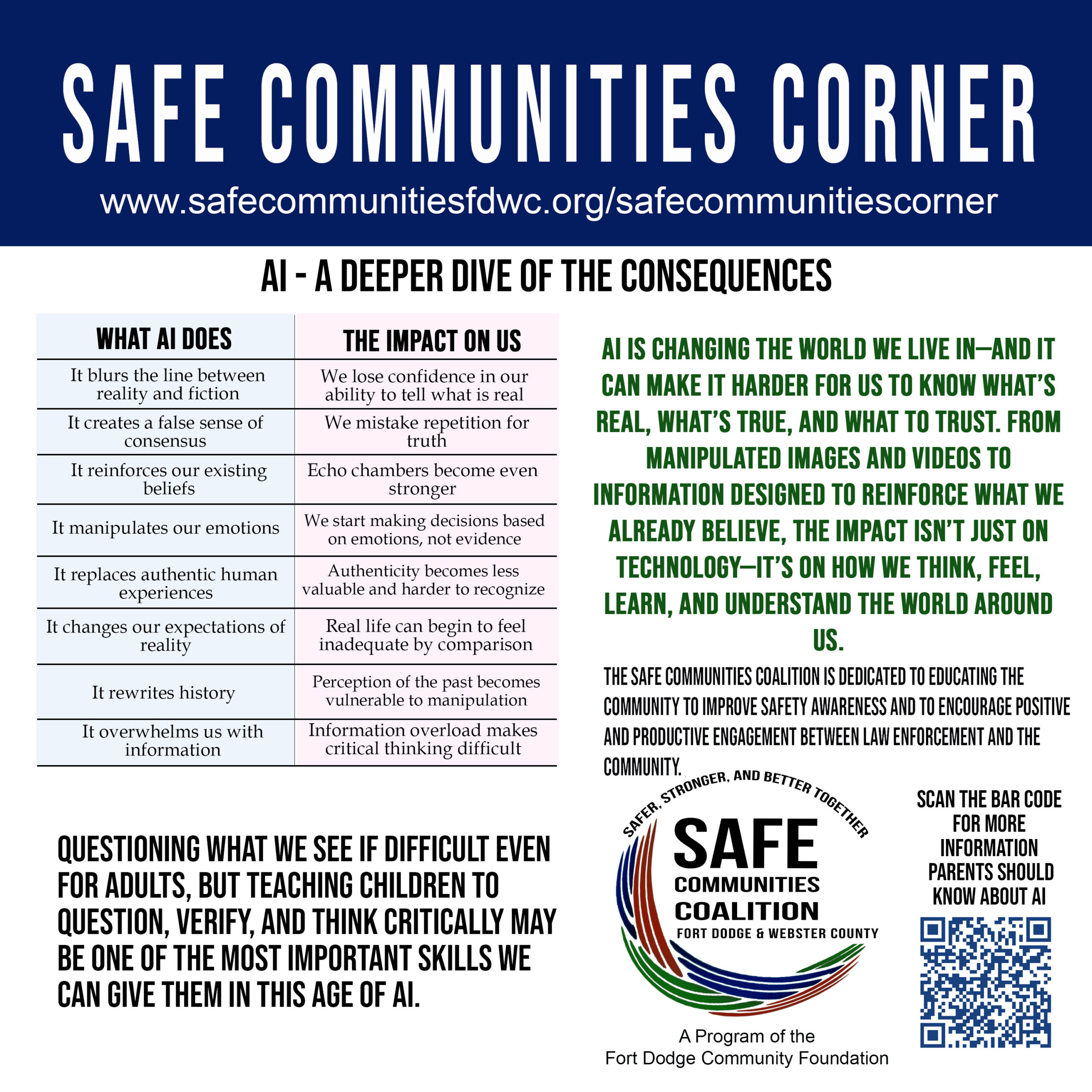
Our graphic looks at eight ways AI can influence us and the potential consequences.
1. AI Blurs the Line Between Reality and Fiction
We can lose confidence in our ability to tell what is real.
AI can create or alter photographs, videos, voices, and conversations so convincingly that it can be difficult to tell what actually happened.
For children, this makes media literacy more important than ever. Teach them to ask:
- Who created this?
- Where did it come from?
- Can I verify it somewhere else?
- What evidence supports it?
Seeing something online is no longer proof that it is real.
2. AI Can Create a False Sense of Consensus
We can mistake repetition for truth.
When children see the same claim repeatedly online, they may assume it must be true—or that “everyone” believes it.
But repetition isn’t evidence.
Help children understand the difference between:
“I’ve seen this many times.”
and
“I’ve verified that this is true.”
Popularity does not make information accurate.
3. AI Can Reinforce Our Existing Beliefs
Echo chambers can become even stronger.
Technology can personalize what we see based on our interests and previous interactions. Over time, children may find themselves surrounded by information that confirms what they already believe.
Encourage them to ask:
“What would someone who disagrees with me say?”
“What evidence supports this?”
“Have I looked at another reliable source?”
The goal isn’t to tell children what to believe. It’s to teach them how to think.
4. AI Can Influence and Manipulate Our Emotions
We may make decisions based on emotion instead of evidence.
AI can help create content designed to capture attention and provoke strong emotional reactions—fear, anger, excitement, or outrage.
For children and teenagers, this can be particularly powerful.
Teach them to pause when something makes them feel extremely emotional and ask:
“Why is this making me feel this way?”
“Is someone trying to get a reaction from me?”
Strong emotions can make critical thinking harder.
5. AI Can Replace Authentic Human Experiences
Authenticity can become harder to recognize.
AI can now generate writing, artwork, music, photographs, voices, and conversations.
Technology can be useful, but children also need to understand the value of experiences that are genuinely human—a handwritten note, a conversation with a grandparent, creating something imperfectly, or simply spending time with another person.
Technology should enhance human connection, not replace it.
6. AI Can Change Our Expectations of Reality
Real life can begin to feel inadequate by comparison.
AI can create images of seemingly perfect people, homes, vacations, bodies, and lifestyles.
Children may compare their real lives with something that was digitally created and never existed in reality.
That can affect how they see themselves and their own lives.
Help children understand the difference between what is real and what is digitally created or enhanced.
7. AI Can Rewrite History
Our understanding of the past can become vulnerable to manipulation.
AI makes it easier to alter photographs, generate audio, create videos, and produce convincing written material.
For children learning about history and current events, this makes understanding sources especially important.
Teach them to ask:
- Who created this?
- When was it created?
- What evidence supports it?
- Can the information be independently verified?
The more convincing technology becomes, the more important verification becomes.
8. AI Can Overwhelm Us With Information
Too much information can make critical thinking difficult.
AI can produce enormous amounts of information almost instantly. For children, it can become difficult to determine what’s accurate, relevant, biased, or trustworthy.
There’s also a risk that children will use AI to provide answers without actually learning how to reach those answers themselves.
Encourage children to use AI as a learning tool—not a replacement for thinking.
Instead of:
“Give me the answer.”
Try:
“Help me understand how to solve this.”
What Can Parents Do?
Parents don’t need to keep children away from AI. They need to help them learn how to navigate it.
Teach children to:
- Pause before believing or sharing something.
- Verify information instead of accepting the first answer.
- Question images, videos, and online claims.
- Recognize emotional manipulation.
- Consider different perspectives.
- Value real-world relationships and experiences.
- Think critically—even when technology provides an easy answer.
The Conversation We Need to Have
Our children don’t need to be afraid of artificial intelligence. They need to be curious, skeptical, thoughtful, and equipped to question what they’re seeing.
Because in a world where technology can increasingly create something that looks real, sounds real, and feels real—
critical thinking may be one of the most important forms of protection we can give our children.
Safe Communities Corner
The Safe Communities Coalition is dedicated to educating the community, improving safety awareness, and encouraging positive and productive engagement between law enforcement and the community.
Safer. Stronger. Better Together.