
Safe Communities Corner
Does AI Control Us, or Do We Control It?
Artificial intelligence has quickly become part of our everyday lives. We use it to answer questions, write, create images, solve problems, find information and make our lives a little easier.
But as AI becomes more powerful, there is an important question we should all be asking:
Are we using AI, or are we allowing AI to influence us without even realizing it?
Recently, I was reminded just how easily AI-generated content can influence people.
A Photograph That Wasn’t Real
I came across a photograph involving a political candidate who is running on a platform of moderation.
The photograph appeared to show the candidate posing with two political extremists, surrounded by a significant amount of social-issue propaganda.
The message behind the photograph seemed pretty clear: This candidate says he’s a moderate, but look who he’s standing with.
And it was working.
There were several negative comments about the candidate. Some people went even further, saying the photograph had influenced their opinion and that they were now reconsidering whether they would vote for him.
There was just one problem.
The photograph wasn’t real.
A simple image search revealed that the photograph had been AI-generated.
Think about that.
A photograph that never actually happened had already begun influencing people’s opinions about a real person. People were reacting to it, commenting on it and potentially making an important decision based on something that was completely fabricated.
And that is what should concern all of us.
This isn’t really about politics. It could happen with a photograph of a neighbor, a business owner, a teacher, a community leader, or anyone else.
A fake image can make it appear that someone was somewhere they weren’t, associated with people they don’t know, said something they never said or did something they never did.
And because we’re accustomed to thinking of photographs as evidence, our first instinct can be to believe what we’re seeing.
But seeing is no longer necessarily believing.
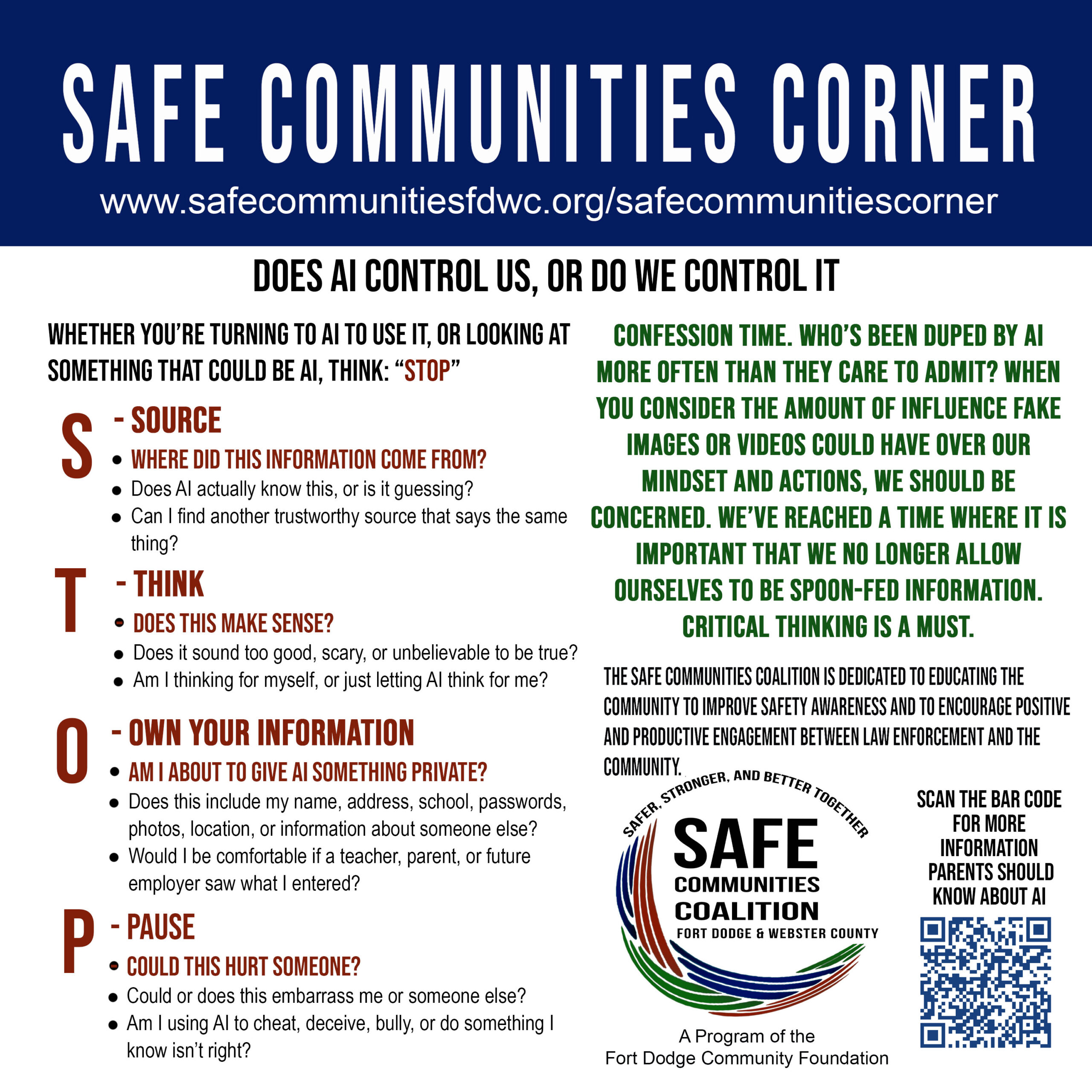
That’s why the graphic accompanying this month’s Safe Communities Corner focuses on a simple word:
STOP
It’s a reminder to slow down and think before we allow AI, or anything we see online, to influence us.
S – SOURCE
Where did this information come from?
Before believing or sharing something, look at the source.
Who originally posted it? Is it coming from a credible news organization, government agency, professional organization or identifiable source? Or has it simply been reposted across social media?
When using AI, ask another important question:
Does AI actually know this, or is it guessing?
AI can produce an answer that sounds extremely confident while still being wrong. That’s why important information should be checked against trustworthy sources.
Don’t just ask:
“What does AI say?”
Ask:
“How do I know this is true?”
T – THINK
Does this make sense?
Take a moment to think critically about what you’re seeing.
Does it sound too good to be true?
Does it seem designed to make you angry or afraid?
Does the photograph actually prove what someone claims it proves?
Does something seem suspiciously perfect, or suspiciously outrageous?
And perhaps the most important question:
Am I thinking for myself, or am I letting technology think for me?
Our emotions can make us especially vulnerable to misinformation.
If something immediately makes you angry, frightened or excited, that’s a good reason to slow down rather than speed up.
O – OWN YOUR INFORMATION
Am I about to give AI something private?
AI isn’t just something we consume. It’s something we interact with.
We type information into it. We upload photographs. We ask it questions about our lives.
Before doing that, stop and consider what you’re sharing.
Is it your:
- Name
- Address
- School
- Phone number
- Password
- Location
- Personal photographs
- Financial information
- Private conversations
- Information about someone else
Ask yourself:
Would I be comfortable if a parent, teacher or future employer saw what I entered?
If the answer is no, think twice before sharing it.
Our personal information has value. We shouldn’t automatically hand it over simply because a technology asks for it.
P – PAUSE
Could this hurt someone?
AI can create things that are funny, creative and harmless.
It can also create things that cause real harm.
Before creating or sharing something, ask:
Could this hurt someone?
Could it embarrass someone?
Could it damage someone’s reputation?
Could it be used to deceive someone?
Could it be considered bullying?
Am I creating something that I already know isn’t right?
Technology gives us tremendous capabilities, but having the ability to do something doesn’t mean we should do it.
The New Reality: Pictures Can Lie
For generations, we’ve been told that a picture is worth a thousand words.
But today, we need to add something to that saying:
A picture is only worth a thousand words if it’s real.
AI can create remarkably realistic photographs and videos. A person can be placed somewhere they never were. People can be made to appear together when they never met. A video can make someone appear to say something they never said.
And sometimes, these creations are difficult to recognize just by looking at them.
That’s why we can’t rely solely on our eyes anymore.
We have to rely on critical thinking and verification.
We’ve All Been Fooled
Here’s the uncomfortable truth:
None of us are immune to being fooled by AI.
It doesn’t matter how old you are or how comfortable you are with technology.
The tools are becoming increasingly sophisticated.
The goal isn’t necessarily to become an expert at identifying every AI-generated image or video. Instead, we need to develop a habit of pausing before we react.
When something seems unbelievable, investigate it.
When something makes you furious, take a breath.
When something confirms exactly what you already believed, be especially careful.
And before you share it with everyone you know, ask:
Do I know this is true?
Does AI Control Us, or Do We Control It?
We can’t control everything other people create with AI.
But we can control what we believe, what we share, what information we provide and how we use the technology ourselves.
That’s why the Safe Communities Coalition encourages everyone to remember:
S — SOURCE
Where did this information come from?
T — THINK
Does this make sense?
O — OWN YOUR INFORMATION
Am I about to give AI something private?
P — PAUSE
Could this hurt someone?
The photograph I encountered was convincing enough that people were already forming opinions before anyone stopped to verify it.
A simple search changed the story completely.
That extra step mattered.
The next time you see a shocking photograph, unbelievable video, sensational headline or AI-generated answer that seems just a little too perfect, don’t immediately react.
STOP.
Take a breath.
Check the source.
Think critically.
Protect your information.
And then decide what you believe and whether it is worth sharing.
Technology is becoming smarter. We need to become smarter about how we use it.
Don’t let AI do your thinking for you.